
What Does CPR Certification Include? A Complete Breakdown of What You'll Learn
You've signed up for a CPR certification course. The date is on your calendar, your spot is reserved, and now a very reasonable question starts forming in your mind: what exactly am I about to learn? Is this a few hours of watching someone demonstrate chest compressions on a mannequin, or is there more to it than that?
That uncertainty is completely normal. Most people sign up for CPR certification because it's required for a job, recommended by an employer, or simply feels like the responsible thing to do. But walking into a course without knowing what to expect can make the experience feel overwhelming before it even begins.
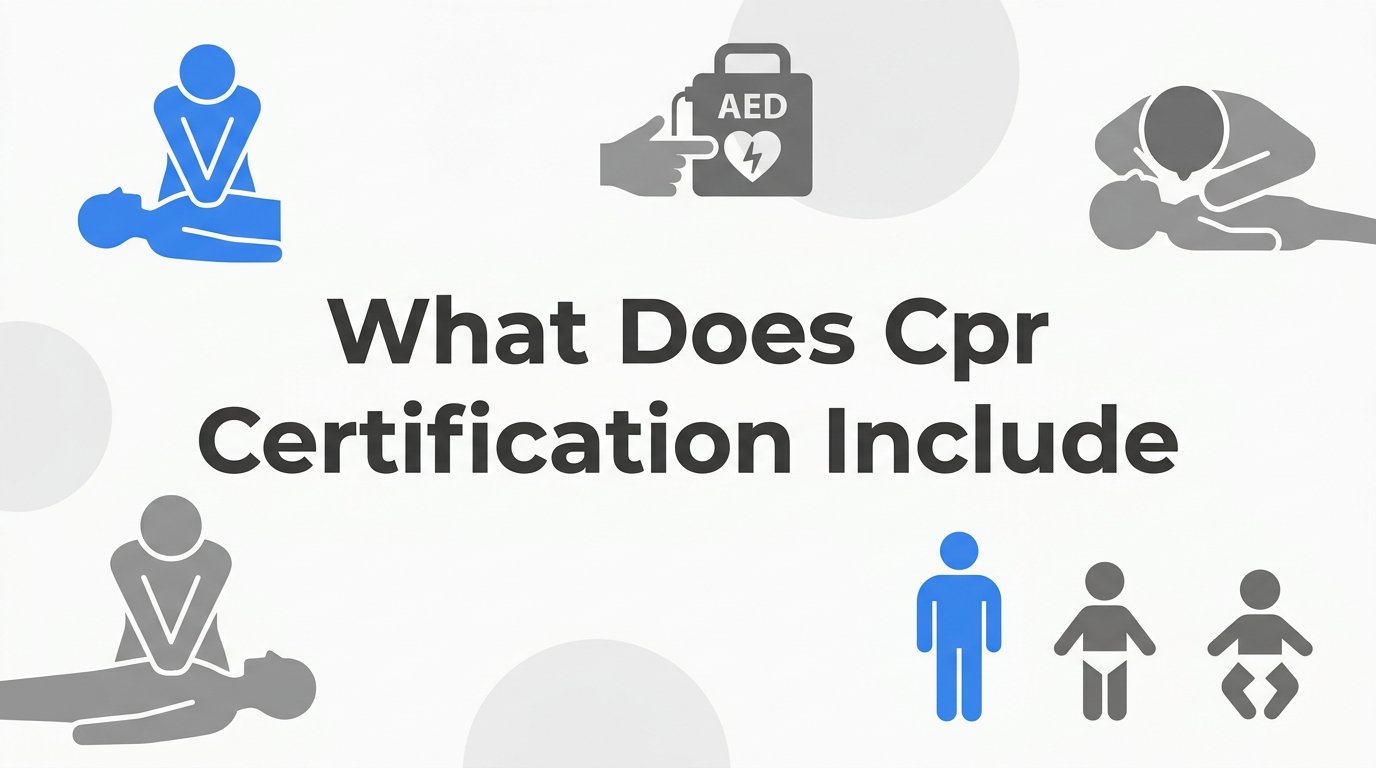
Here's the reassuring truth: CPR certification programs are structured, logical, and far more comprehensive than most people anticipate. Yes, chest compressions are part of it. But so is AED training, rescue breathing, emergency recognition, and age-specific techniques for helping adults, children, and infants. The specific content you'll cover depends on the course type you choose, and that's worth understanding before you register.
This breakdown covers everything a typical CPR certification course includes, how different course types shape what you learn, and what you walk away with at the end. Whether you're a healthcare professional pursuing BLS certification or a workplace safety coordinator completing a Heartsaver course, this guide will help you know exactly what to expect.
The Core Skills Every CPR Certification Course Covers
Regardless of which certification level you pursue, every CPR course is built around a foundation of hands-on physical skills. These aren't concepts you simply read about and check off a list. They're techniques you practice on a mannequin until they become second nature, because in an actual emergency, muscle memory matters more than anything you memorized from a handout.
Chest compressions are the cornerstone of the entire curriculum. You'll learn proper hand placement, which for adult CPR means interlacing your fingers and positioning the heel of your lower hand on the center of the chest, over the sternum. Compression depth matters significantly: for adults, you're aiming for at least two inches with each push. You'll also learn the correct rate, which is 100 to 120 compressions per minute, a pace that instructors often describe as roughly matching the beat of a well-known upbeat song.
One detail that surprises many new learners is the emphasis on full chest recoil between compressions. Allowing the chest to fully rise between each push is not optional. It's what allows the heart to refill with blood before the next compression. Pressing down again before the chest has fully recoiled reduces the effectiveness of each cycle, which is why instructors spend real time reinforcing this habit during practice.
Rescue breathing is the other major physical component. You'll learn when to deliver rescue breaths, how to open the airway using the head-tilt chin-lift technique, and how to create a proper seal over the mouth to ensure air actually enters the lungs rather than escaping. Breath volume is another key detail: you're delivering just enough air to see the chest rise, not a forceful blast that could cause complications.
The CPR cycle combines both skills in a specific ratio. For adult CPR, the standard sequence is 30 chest compressions followed by two rescue breaths. That ratio isn't arbitrary. It reflects decades of research into how the body responds during cardiac arrest, balancing the need to circulate blood with the need to deliver oxygen. Understanding why the sequence works the way it does helps learners remember and execute it correctly under pressure.
These three elements, compressions, rescue breathing, and the correct cycle, form the non-negotiable core of what CPR certification includes. Everything else in the course builds outward from this foundation.
AED Training: The Component Most People Underestimate
Ask someone what CPR certification covers, and they'll almost always mention chest compressions. Ask them about AED training, and you'll often get a blank look. Yet AED use is built into most standard CPR certification programs, and for good reason. An automated external defibrillator can be the difference between a successful resuscitation and a tragic outcome when cardiac arrest involves a shockable heart rhythm.
An AED is a portable device that analyzes the heart's electrical activity and, when appropriate, delivers a controlled electrical shock to restore a normal rhythm. The word "automated" is key here: the device does the analysis for you. It tells you whether a shock is needed. Your job as a rescuer is to set it up correctly, follow the prompts, and keep everyone safe during the process.
During your certification course, you'll practice the full AED sequence using a training device. The steps you'll rehearse include:
1. Powering on the device by lifting the lid or pressing the power button, which immediately triggers audio instructions that guide you through every subsequent step.
2. Placing the pads correctly on the victim's bare chest, one pad below the right collarbone and one on the lower left side of the chest. Proper pad placement ensures the device can accurately read the heart's rhythm and deliver a shock along the correct path through the body.
3. Following the audio prompts, which instruct you to stop CPR, stand clear, and allow the device to analyze the rhythm. The AED will tell you whether a shock is advised. If it is, you'll press the shock button after confirming that no one is in contact with the victim.
4. Resuming CPR immediately after the shock is delivered, without waiting to see whether the shock worked. The device will prompt you to continue compressions while it monitors the situation.
You'll also learn how to coordinate AED use within a two-rescuer scenario, which is common in workplace environments where a colleague may be present. One person maintains compressions while the other retrieves and sets up the AED. Knowing how to hand off roles smoothly, without interrupting compressions for longer than necessary, is a practical skill that certification courses build through repeated practice.
Early defibrillation alongside early CPR significantly improves survival outcomes in cardiac arrest. That's why the two skills are taught together rather than as separate courses.
Who You're Learning to Help: Age-Specific Techniques
One of the most important things to understand about CPR certification is that the technique is not one-size-fits-all. The way you perform CPR on an adult is meaningfully different from how you perform it on a child or an infant, and those differences matter for both effectiveness and safety.
For adults, you use both hands for compressions, pressing down at least two inches with each push. For children (generally defined as ages one through puberty), you may use one or two hands depending on the child's size, and the target compression depth is about two inches, slightly adjusted based on the child's chest. For infants under one year old, you use just two fingers placed on the center of the chest, just below the nipple line, with a compression depth of about one and a half inches. Rescue breath volume also decreases with age: for infants, you deliver small puffs of air, just enough to see the tiny chest rise.
Most standard CPR certification courses, including the AHA Heartsaver CPR AED program, cover both adult and child CPR techniques. Some courses also include infant CPR, while others offer it as part of a more specialized curriculum. If your professional role involves caring for infants, such as a childcare provider, pediatric nurse, or new parent, you'll want to confirm that infant CPR is explicitly included in the course you're registering for.
This is also where course selection becomes a practical decision rather than just a formality. An office safety coordinator responsible for adult employees may find that a standard Heartsaver course covers everything they need. A childcare worker, school nurse, or pediatric healthcare professional will want to ensure their certification includes infant and pediatric techniques at the appropriate depth.
Choosing the right course scope from the start means you leave with skills that are actually relevant to the emergencies you're most likely to encounter in your specific environment.
Reading the Room: Emergency Assessment Skills Built Into Training
Knowing how to perform CPR is only part of what makes a certified responder effective. The other part is knowing when and whether to start, which requires a set of assessment skills that are woven throughout every certification course.
Scene safety assessment comes first, always. Before you approach a person who appears to be in distress, you need to quickly evaluate whether the environment is safe for you to enter. A victim near downed power lines, in a smoke-filled room, or in traffic requires a different response than one collapsed in an office hallway. Certification training reinforces this habit because an injured rescuer cannot help anyone.
Checking for responsiveness is the next step. You tap the person's shoulders firmly and call out to them. If there's no response, you move to the next phase: calling for help. In most situations, this means directing a specific bystander to call 911 and retrieve an AED rather than making a general announcement to the crowd. Bystander paralysis is a real phenomenon, and training you to assign tasks by pointing at individuals is a deliberate technique for overcoming it.
Identifying cardiac arrest versus other emergencies is a skill that receives meaningful attention in certification courses. Not every unresponsive person is in cardiac arrest. Checking for normal breathing is a key distinguishing step. Gasping or agonal breathing, which can look like breathing but is not effective, is a sign of cardiac arrest rather than a reason to hold off on CPR. Certification training helps you recognize these nuances so you can respond appropriately rather than hesitating at a critical moment.
You'll also learn when CPR is not appropriate, such as when obvious signs of death are present or when a valid do-not-resuscitate order is known to be in effect. These are scenarios that instructors address directly so that responders feel equipped to make sound decisions rather than defaulting to action out of panic.
How the Course Type Shapes What You Learn
Not all CPR certifications are the same, and understanding the differences helps you choose the program that actually fits your role, your workplace requirements, and your personal goals.
The AHA Heartsaver CPR AED course is designed for lay rescuers and workplace responders: people who are not healthcare professionals but need reliable, recognized certification. It covers adult and child CPR, AED use, and relief of choking for adults and children. This is the appropriate choice for office safety coordinators, teachers, fitness professionals, and anyone who needs a broadly recognized certification for a non-clinical setting.
The AHA BLS (Basic Life Support) certification is designed for healthcare professionals and requires a higher level of skill proficiency. BLS courses cover everything in a Heartsaver course and add two-rescuer CPR, bag-mask ventilation, and team communication within a clinical resuscitation context. If you're a nurse, medical assistant, EMT, dental hygienist, or other licensed healthcare provider, BLS is typically what your employer or licensing board requires. It is not interchangeable with a Heartsaver certification for clinical roles.
First Aid add-ons expand the scope of a Heartsaver program to include wound care, burn treatment, choking response for infants, and other basic first aid skills. Many workplace safety programs pair CPR AED certification with First Aid training to create a more comprehensive responder credential. Bloodborne pathogen awareness is another commonly paired training, particularly relevant for healthcare workers, childcare providers, and anyone whose role involves potential exposure to bodily fluids.
Course format is another variable worth understanding. In-person courses deliver all instruction and hands-on practice in a single classroom session. Blended learning courses, which the AHA refers to as HeartCode programs, combine an online portion covering concepts and knowledge with a required in-person skills session for hands-on practice and testing. Online-only courses do not include a hands-on component and, importantly, do not result in an AHA certification card. If your employer or licensing board requires a recognized certification, confirm that the course format you're considering includes the skills component necessary to receive that credential.
What You Walk Away With After Certification
Completing a CPR certification course results in more than a sense of accomplishment. You receive a physical or digital certification card that serves as your official proof of training.
A standard CPR certification card includes your name, the course name and level completed, the date of completion, and the expiration date. It is issued by the certifying organization, such as the American Heart Association, and bears the organization's branding. This is what employers, HR departments, licensing boards, and credentialing bodies ask to see when verifying your training status. It's worth keeping it accessible, whether in your wallet, your employee file, or a digital copy stored on your phone.
CPR certification through the AHA is valid for two years from the date of completion. After that point, your certification lapses and you'll need to complete a renewal course to restore your active status. Renewal courses are typically shorter than initial certification courses because they assume a baseline of prior knowledge and focus on refreshing skills and reviewing any updated guidelines. Many organizations now recommend scheduling your renewal before your card actually expires to avoid a gap in coverage.
Before you receive your certification card, you'll complete a skills test or final assessment. In a Heartsaver course, this typically involves demonstrating correct CPR technique and AED use on a mannequin while an instructor evaluates your performance against established criteria. In a BLS course, the assessment may also include two-rescuer scenarios and bag-mask ventilation. There is no written exam in most standard CPR certification programs, but the skills check is not optional. You must demonstrate competency to receive your card.
If you don't pass a particular skill on the first attempt, instructors will typically coach you through it and give you the opportunity to try again. The goal of certification training is competence, not failure, and most instructors are genuinely invested in making sure every participant leaves prepared.
Putting It All Together
CPR certification is a far more complete education than most people expect before they walk through the door. It covers chest compressions, rescue breathing, and the correct CPR cycle. It includes hands-on AED training. It teaches you how to adapt your technique for adults, children, and infants. It builds emergency assessment skills that help you recognize when to act and how to act safely. And depending on the course level you choose, it may also include First Aid skills, two-rescuer coordination, and clinical-level techniques for healthcare settings.
The right certification for you depends on your role. A healthcare professional needs BLS. A workplace safety coordinator or general responder is well-served by a Heartsaver CPR AED course. Someone who works with children or infants should confirm that pediatric and infant techniques are included in their chosen program.
Whatever your starting point, the most important step is simply taking the course. Don't wait until an emergency happens. Equip yourself with life-saving CPR skills that could make all the difference when seconds count. Register for a certification class today and gain the confidence to respond when someone needs help most. Best Choice CPR offers Heartsaver CPR AED, BLS certification, and combined First Aid programs designed to meet you exactly where you are.