
9 Best Group CPR Training Providers for Companies in 2026
Certifying an entire department in CPR usually comes down to logistics as much as curriculum. A safety coordinator or HR manager needs to know whether a provider can send an instructor to the office, how many people can train at once, whether the certification will actually satisfy a hospital credentialing office or an OSHA auditor, and what a bulk booking will cost before the invoice arrives. The providers below were compared on exactly those points: group scheduling options, onsite versus virtual versus blended delivery, alignment with American Heart Association (AHA) or American Red Cross standards, and how transparent each one is about pricing for group bookings.
Quick Comparison
- Best Choice CPR: best for companies that want onsite, hands-on group certification at their own workplace; quote-based pricing; the only provider on this list built specifically around bringing instructors to the employer's site for group sessions.
- American Red Cross: best for employers wanting widely recognized certification with flexible blended scheduling; pricing varies by chapter; corporate accounts let HR track recertification across the workforce.
- American Heart Association (Authorized Training Centers): best for healthcare employers requiring BLS specifically; quote-based through local Training Centers; the eCard system is the standard credential many hospitals check first.
- National Safety Council: best for industrial or construction employers; pricing varies by group size; bundles CPR with broader occupational safety training.
- HSI (Health & Safety Institute): best for schools, fitness centers, and hospitality businesses; quote-based; offers an employer dashboard for tracking certification expiration across staff.
- ProCPR: best for distributed teams needing lower-cost compliance training; pricing varies with bulk discounts; fully online with bulk seat purchasing.
- National CPR Foundation: best for non-clinical workplaces needing fast, cheap certificates; pricing typically among the lowest online options; same-day certificate issuance with no in-person requirement.
- ProTrainings: best for companies bundling CPR with OSHA compliance training; quote-based; the admin portal is built specifically for reporting on group completion.
1. Best Choice CPR
Best Choice CPR provides onsite group CPR, First Aid, BLS, and AED certification for companies, sending instructors directly to the workplace so a whole team can train together during work hours rather than sending employees offsite individually.
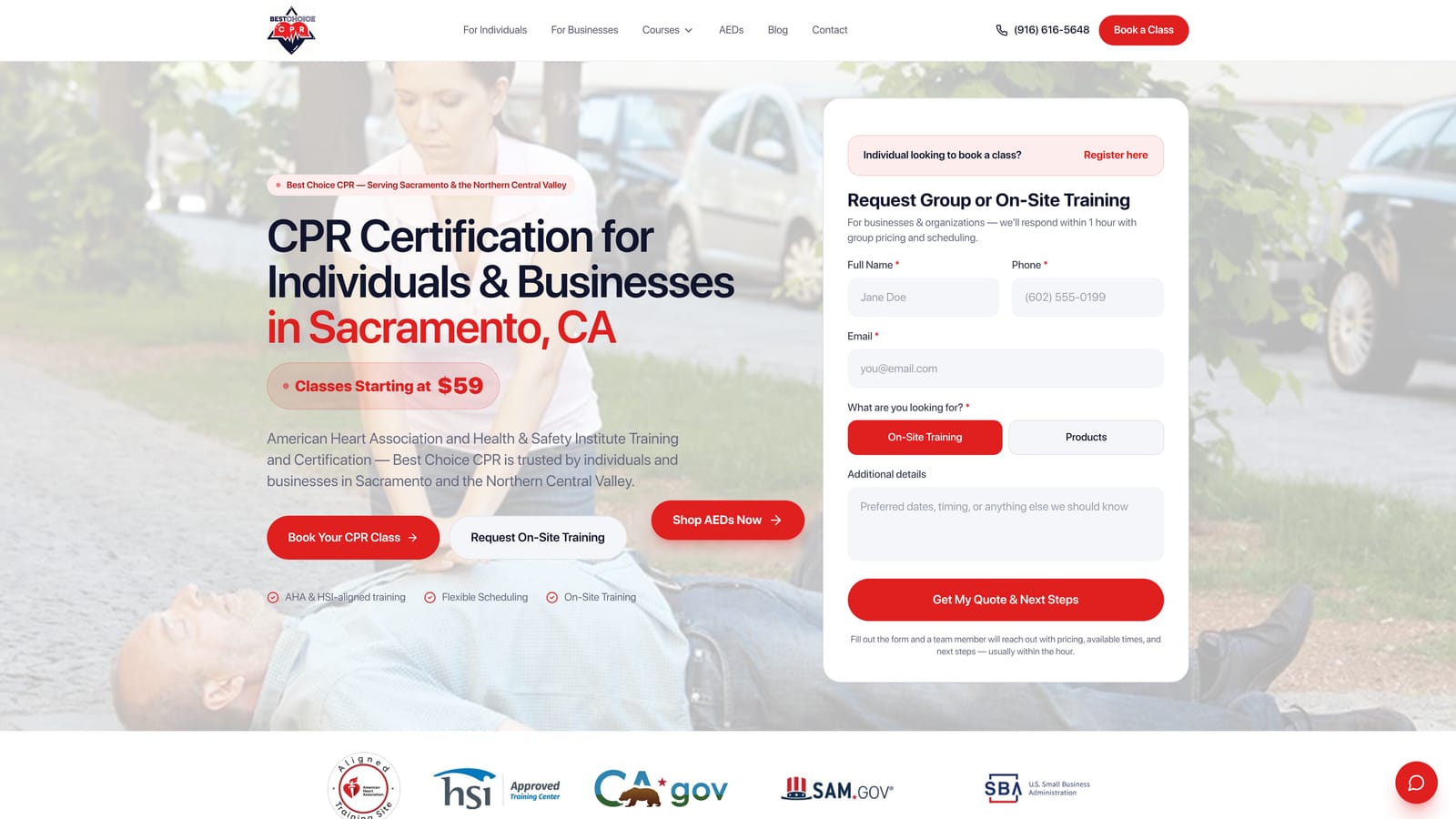
What sets this provider apart on this list is that its delivery model is built around group and corporate scheduling from the ground up, rather than adapting an individual-enrollment class to fit a group. Employers work with an instructor to set a date, and the entire team trains together in one session, which cuts down on the scheduling friction of coordinating multiple employees around separate class times.
- Onsite group CPR, First Aid, BLS, and AED classes held at the employer's own location
- Group and corporate pricing structured for teams instead of per-person walk-in rates
- Instructor-led, hands-on skills practice rather than an online-only certification path
- Course tracks for both general workplace staff and healthcare roles that require BLS specifically
There is no software integration to speak of, since this is an in-person training service rather than a learning management platform. Setup is straightforward: a company contacts Best Choice CPR, confirms headcount and preferred course type, and an instructor is scheduled for the group session.
The main limitation is that availability depends on instructor scheduling within the company's local service area, so it works best for planned group sessions booked with reasonable lead time rather than same-day or single-person enrollments. Pricing is quote-based, since group rates depend on headcount and location as of 2026, so companies should contact Best Choice CPR directly for a quote rather than expecting a published per-seat rate.
Best for: Companies that want hands-on group certification delivered at their own workplace.
2. American Red Cross
The American Red Cross offers CPR, First Aid, and AED certification through blended and in-person formats, with corporate account options designed for managing group training across a workforce rather than one employee at a time.
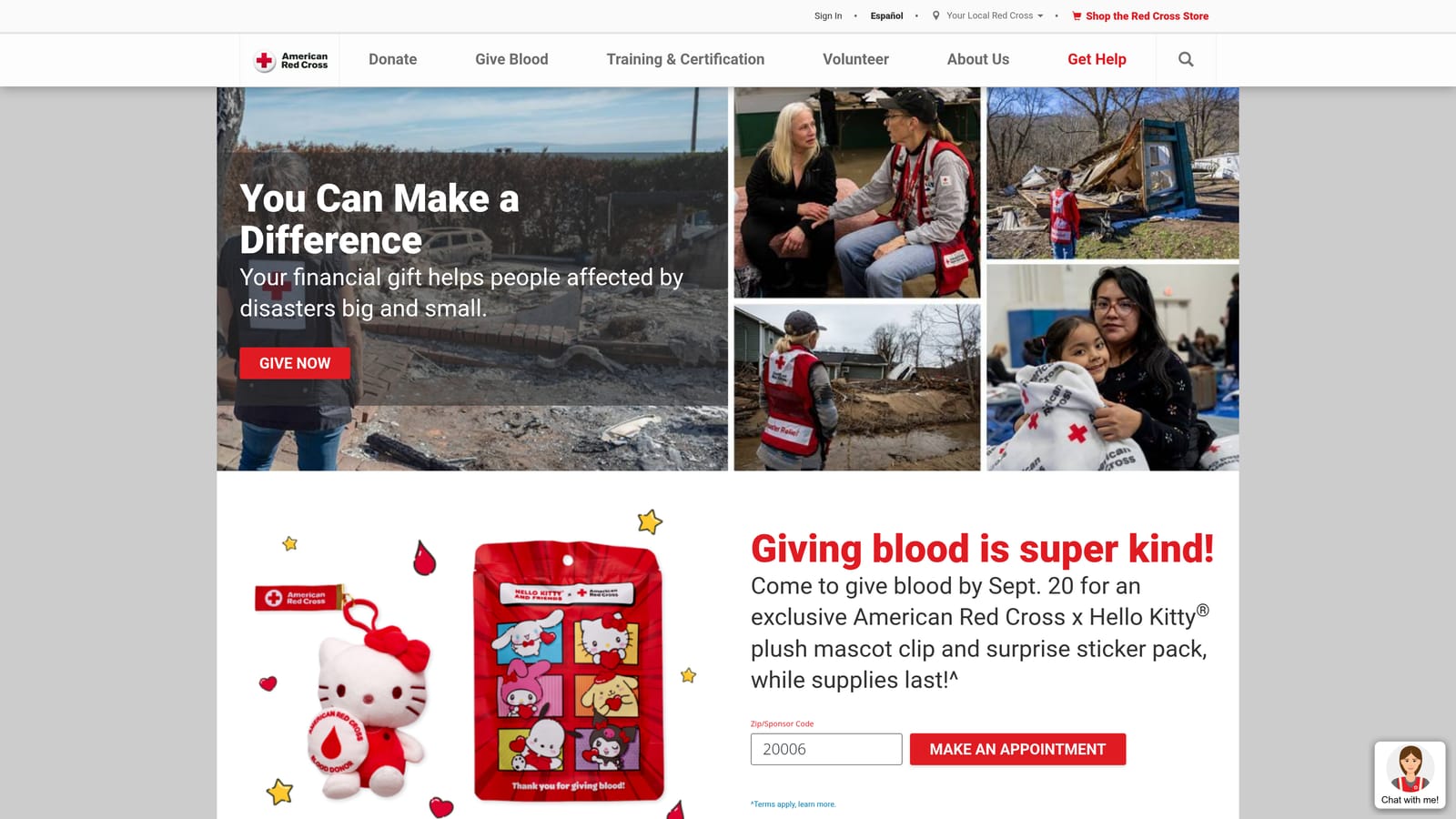
Its blended learning format, which pairs online coursework with a shorter in-person skills check, is a genuine advantage for larger groups because it reduces the amount of classroom time needed once employees arrive for the hands-on portion. That structure lets a coordinator schedule fewer in-person hours while still meeting a hands-on skills verification requirement.
- Blended coursework that combines self-paced online modules with an in-person skills check
- Certification recognized by most employers across healthcare, hospitality, and general workplace settings
- Corporate accounts that let HR schedule and track recurring group recertification over time
- Access through a nationwide network of local training providers and chapters
Because classes are ultimately delivered through local chapters or authorized providers, the exact scheduling process, instructor availability, and pricing depend on which chapter fulfills the booking. That decentralization is also its main drawback: two companies in different regions may have noticeably different experiences setting up the same type of group class.
Pricing is not published as a flat national rate; group pricing varies by location and format as of 2026, so companies should check with their local chapter or the Red Cross website directly.
Best for: Employers needing widely recognized certification with flexible blended scheduling.
3. American Heart Association (Authorized Training Centers)
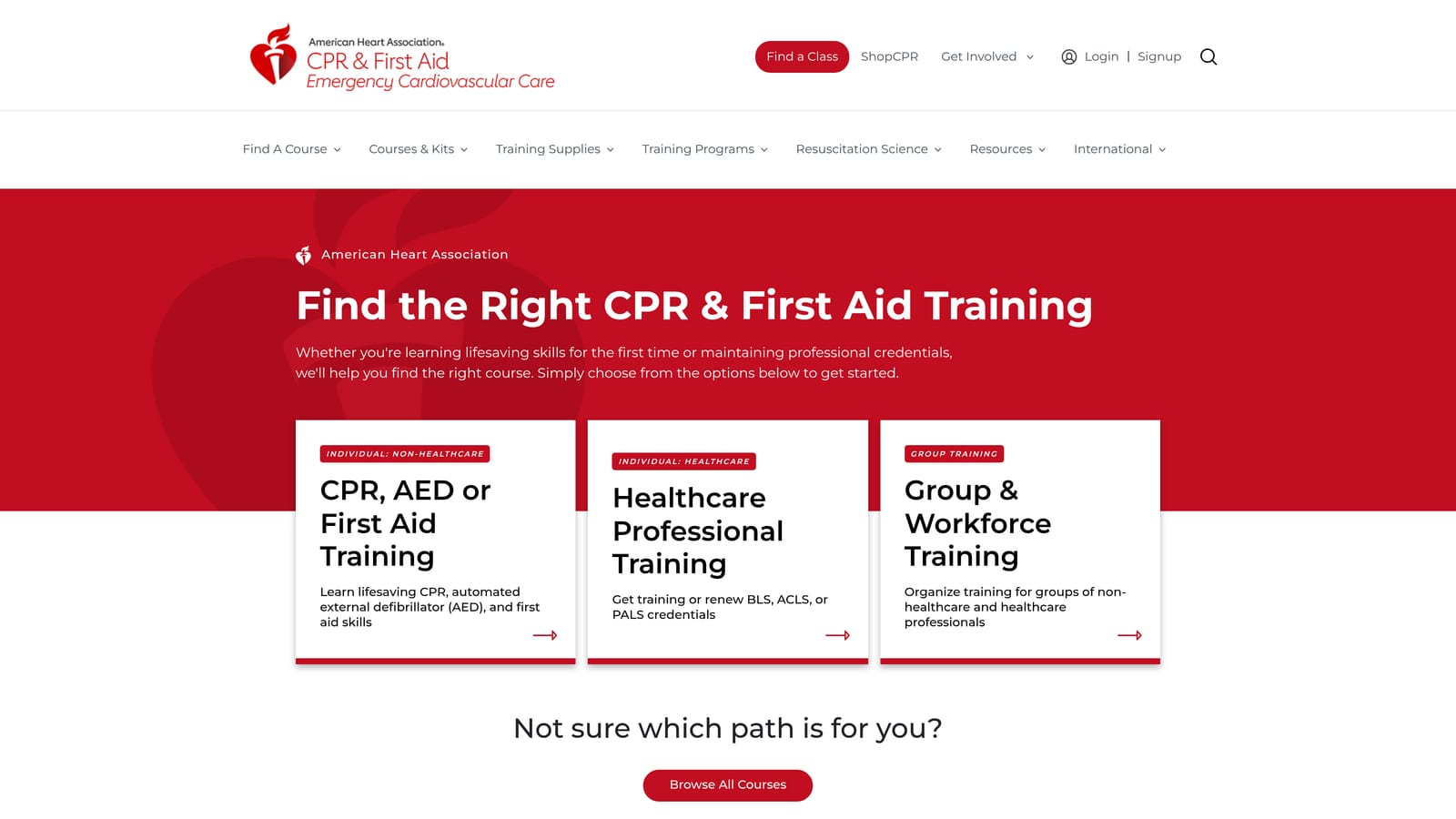
The American Heart Association delivers its BLS and Heartsaver courses through a nationwide network of authorized Training Centers, and for many healthcare employers, AHA BLS certification specifically, not just any CPR card, is a hard requirement written into hiring or credentialing policy.
Two course tracks, one credentialing body
BLS is built for healthcare providers and covers team-based resuscitation scenarios expected in clinical settings. Heartsaver is designed for general workplace employees who need CPR and AED skills but not the clinical depth of BLS. A safety coordinator certifying a mixed group, say, clinical staff alongside front-desk employees, may need to book both course types rather than assuming one covers everyone.
- BLS courses built around the resuscitation skills healthcare employers specifically require
- Heartsaver courses scaled for general workplace employees and non-clinical staff
- A digital eCard system that lets employers verify and track certification status for each employee
- Course delivery through a large network of authorized instructors and Training Centers nationwide
Because delivery is decentralized across independently authorized Training Centers, pricing and scheduling consistency vary from one location to another, which means a coordinator with offices in multiple cities may need to work with several different Training Centers to standardize group certification dates. Pricing is quote-based; contact a local Training Center directly for group rates as of 2026.
Best for: Healthcare employers whose policy specifically requires AHA BLS certification.
4. National Safety Council (NSC)
The National Safety Council folds group CPR and First Aid training into a broader occupational safety curriculum, which makes it a natural fit for employers in industries where CPR readiness is one requirement among several related to injury prevention.
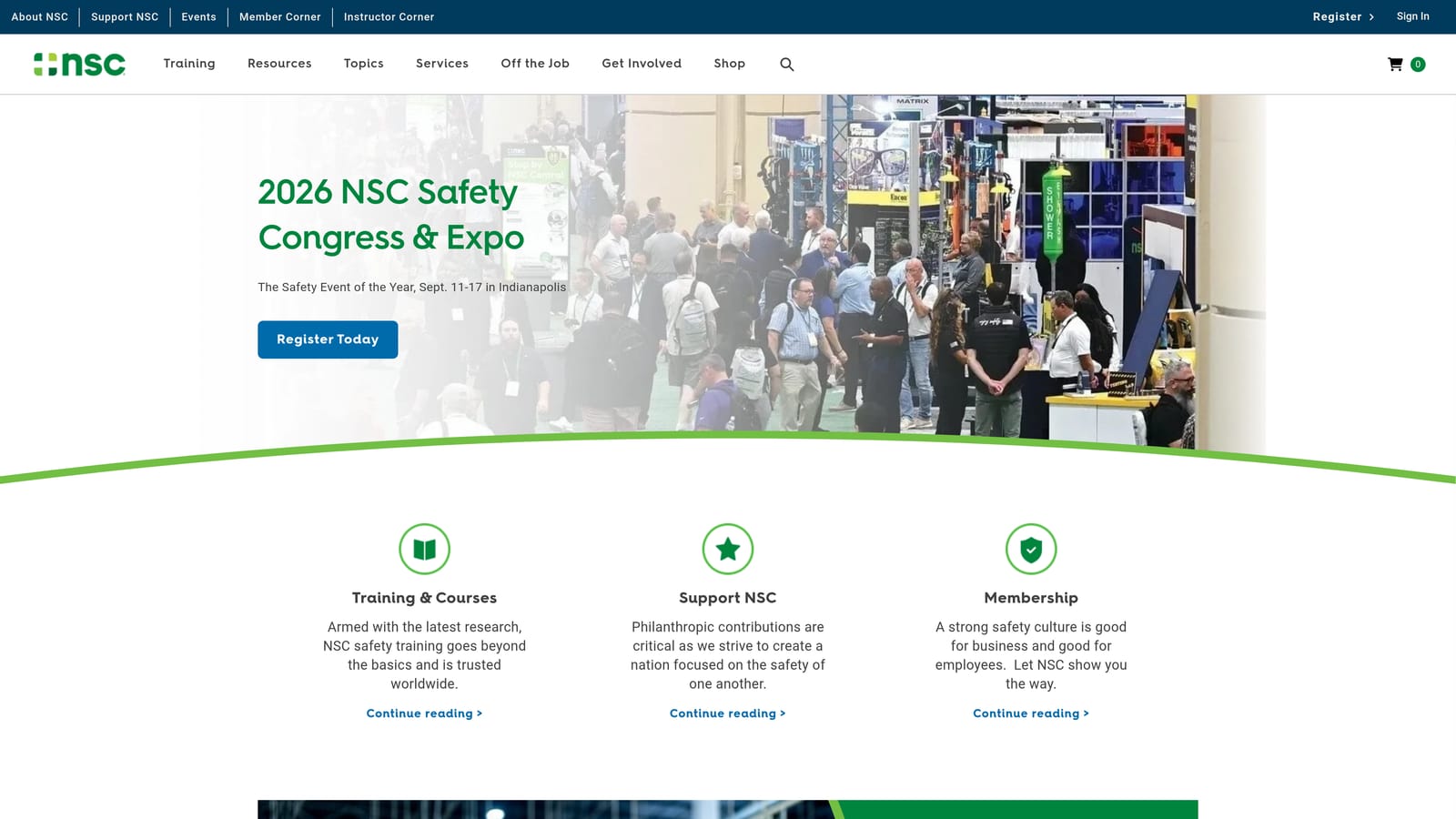
Unlike providers that treat CPR as a standalone certification, NSC's course materials are built with industrial, construction, and manufacturing settings in mind, and its instructor network has experience working in regulated, safety-sensitive workplaces where CPR training often sits alongside forklift safety, fall protection, or hazard communication training.
- CPR and First Aid courses packaged with wider workplace safety curriculum
- Materials adapted for industrial, construction, and manufacturing environments
- Group discounts available once a company reaches a qualifying headcount
- Instructors experienced with OSHA-regulated, higher-risk workplaces
The pricing structure favors larger groups, which means a small office booking a session for five or six employees may find the per-seat cost less competitive than what a 50-person facility would pay. Companies should check the NSC website directly, since group discounts typically require a minimum headcount as of 2026.
This is not the right fit for an employer that just wants a quick, generic CPR card with no additional safety content attached; the value here comes from the bundled compliance curriculum, not a standalone CPR class.
Best for: Industrial or construction employers wanting CPR training bundled with safety compliance.
5. HSI (Health & Safety Institute)
HSI operates several training brands, including MEDIC First Aid, and offers in-person and blended group CPR courses along with employer-facing tools for tracking certification status across a workforce.
One thing HSI does that few others on this list do well is offer course variations tailored to specific industries, schools, fitness centers, and hospitality businesses, so a gym chain or a school district can get a course built around the scenarios their staff are actually likely to encounter, rather than a generic workplace CPR class.
- In-person and blended-learning course formats for group bookings
- Industry-specific course variations for schools, fitness centers, and hospitality settings
- An employer dashboard for tracking certification expiration dates across all staff
- Multiple training brands operating under one parent company
The multi-brand structure is also the source of its main drawback: because HSI operates several sub-brands with overlapping course offerings, comparing exact course content and pricing upfront can take more digging than with a single-brand provider. A coordinator should confirm which specific HSI brand and course format applies to their industry before booking.
Pricing is quote-based for corporate group bookings; check the HSI website for current details as of 2026.
Best for: Employers in schools, fitness, or hospitality needing industry-specific group courses.
6. ProCPR
ProCPR is a primarily online certification platform built around bulk enrollment discounts, which makes it a practical option for companies that want to cover the coursework portion of training for many employees before arranging any required in-person skills check separately.
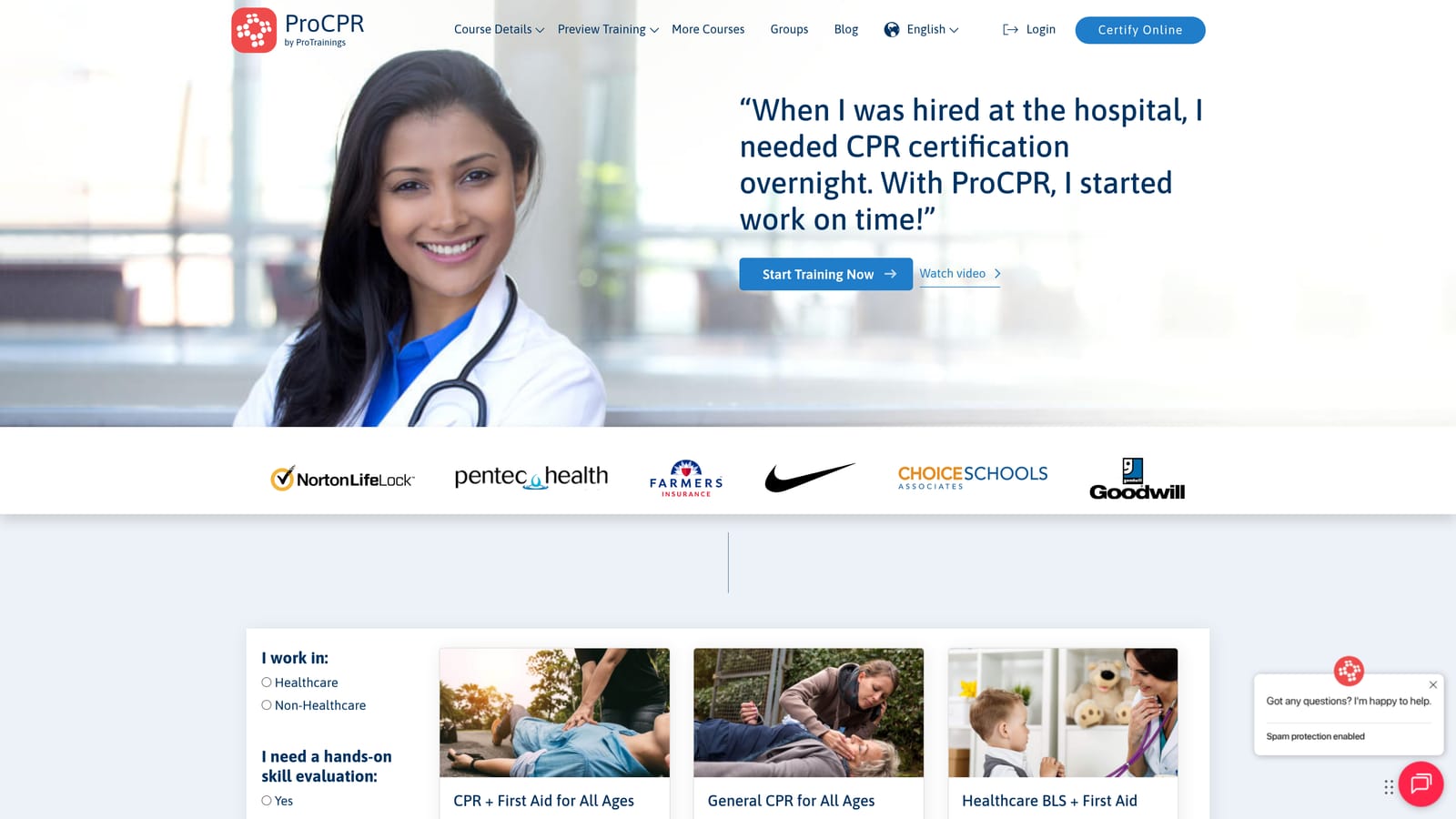
Its self-paced, fully online format lets each employee complete training on their own time rather than requiring a company-wide session, which is useful for teams spread across multiple locations or shifts. Because there's no instructor travel or classroom time built into the cost, per-seat pricing tends to run lower than fully in-person providers.
- Fully online course modules available for bulk purchase by HR or a safety coordinator
- Self-paced format that lets employees finish training around their own schedules
- Lower cost per seat compared with providers that require in-person delivery
- Printable certificates issued immediately upon course completion
The real limitation is recognition: ProCPR's certification is not universally accepted by healthcare employers that specifically require AHA or Red Cross credentials, so a hospital or clinic checking credentials at hire may reject it outright. Companies in regulated healthcare roles should confirm acceptance with their credentialing office before enrolling staff.
Pricing is available on the ProCPR website, with per-seat discounts for bulk HR purchases as of 2026.
Best for: General workplace compliance training for distributed or remote teams.
7. National CPR Foundation
National CPR Foundation offers low-cost, online-only CPR certification with same-day certificate turnaround, aimed squarely at general employee compliance rather than clinical or regulated certification needs.
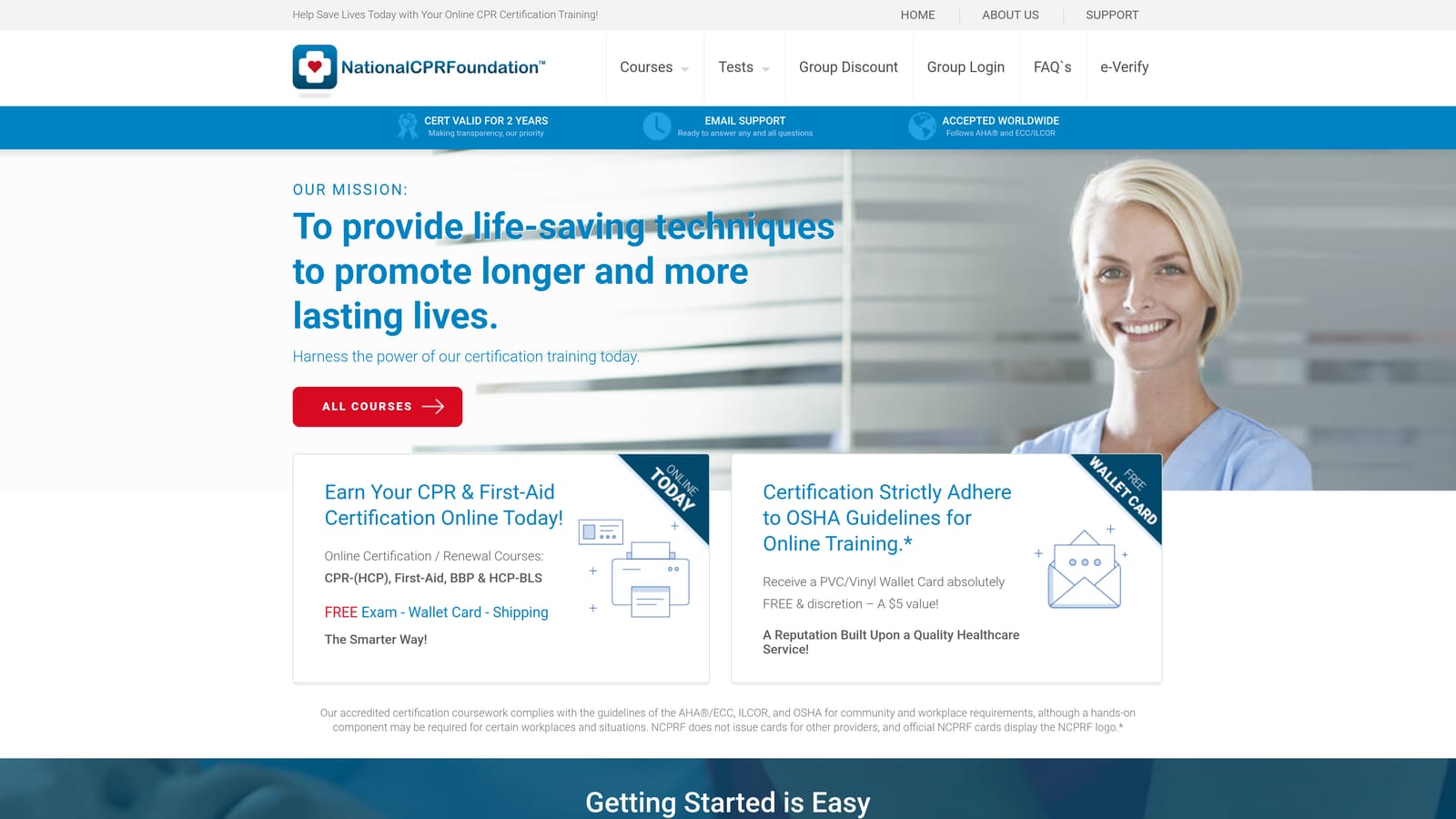
Of the online-only options on this list, this one moves the fastest: an employee can complete the course and receive a certificate the same day, with no scheduling of an in-person skills check required at all. For a large batch of non-clinical employees who just need documentation on file, that speed can matter more than course depth.
- Fully online coursework with same-day certificate issuance
- Budget-friendly pricing structured for certifying large batches of employees at once
- A simple online dashboard for HR to enroll and manage multiple staff members
- No in-person component required to complete certification
The tradeoff is recognition. This certification is not recognized by AHA or Red Cross-dependent employers, which rules it out for regulated healthcare roles, EMS positions, or any employer whose insurance or licensing requirements specify one of those two credentialing bodies by name. Using it for a role that actually requires a hands-on skills check is a common and costly mistake.
Pricing is listed on the website and is typically among the lower-cost online options as of 2026.
Best for: Non-clinical workplaces needing quick, low-cost compliance certificates for many employees.
8. ProTrainings
ProTrainings uses a hybrid model in which employees complete coursework online and then a local instructor conducts the in-person skills evaluation, backed by an admin portal built for managing group progress.
Built for HR reporting, not just individual certificates
What distinguishes ProTrainings from other blended providers on this list is how much attention its admin portal gives to group management. A coordinator can assign courses to a full roster of employees, track who has completed the online module, see who still needs the in-person skills check, and pull reporting on certification status by employee, which matters when an auditor or insurer asks for proof of compliance across a whole team.
- Hybrid online coursework paired with a local in-person skills check
- A group management portal for assigning courses and tracking employee completion
- A broader course library that extends into OSHA-related workplace safety topics
- Reporting tools built specifically for HR to monitor certification status across staff
The in-person skills check still depends on local instructor availability, the same constraint that affects other blended providers on this list, so a company in a smaller market may face longer lead times booking that portion. Pricing, including admin portal access, is quoted per company as of 2026, so check the ProTrainings website for current details.
Best for: Companies bundling CPR certification with other OSHA-related compliance training under one portal.
Matching the Provider to Your Team's Situation
For a team that needs hands-on CPR skills practiced together in one room, particularly healthcare staff, first responders, or safety-sensitive industrial workers, an onsite instructor-led provider like Best Choice CPR removes the scheduling burden of sending employees offsite individually, while the American Heart Association's Training Center network remains the standard when a hospital or clinic requires BLS specifically. If your priority is regulatory acceptance above all else, AHA and the American Red Cross are the two credentialing bodies most employers and licensing boards recognize by name, so confirm which one your industry expects before booking anything else.
For a distributed workforce spread across locations or shifts, a blended or online-first option such as ProCPR or ProTrainings can get large groups certified faster and at a lower per-seat cost, as long as you confirm upfront that the certification will satisfy your specific compliance or credentialing requirement.
Don't wait until an emergency happens. Equip your team with life-saving CPR skills that could make all the difference when seconds count. Register for a certification class today and gain the confidence to respond when someone needs help most.