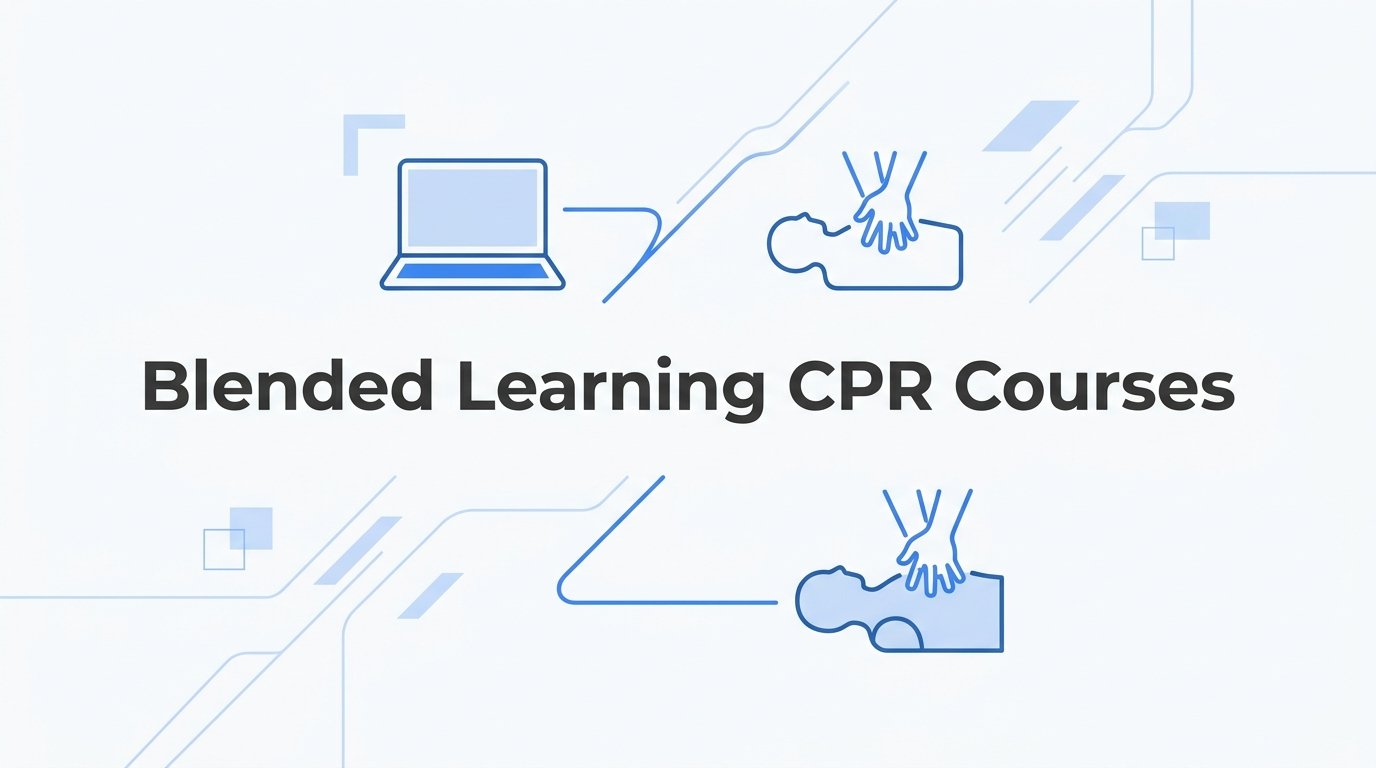
Blended Learning CPR Courses: How They Work and Why They're Worth It
Picture this: you're a nurse manager responsible for getting an entire floor of staff recertified before the end of the quarter. You can't pull everyone off the unit at the same time, and a full-day classroom session simply isn't realistic. Or maybe you're a workplace safety coordinator juggling three different shift schedules, trying to find a training window that works for day, evening, and overnight staff without shutting down operations. Sound familiar?
This is exactly the kind of scheduling puzzle that blended learning CPR courses were designed to solve. Over the past several years, blended learning has changed how organizations, healthcare teams, and individuals approach CPR certification, offering a format that fits into real-world schedules without cutting corners on the hands-on training that actually saves lives.
In the CPR training context, blended learning combines two distinct components: a self-paced online portion that covers the cognitive knowledge behind CPR, and a required in-person skills session where learners practice on manikins, work with AED trainers, and receive direct instructor feedback. The two parts work together as a complete course, and the result is a certification that is recognized by major certifying bodies including the American Heart Association.
This article will walk you through how blended learning CPR courses are structured, who they are built for, and what you can realistically expect from each phase of the training. We'll also clear up some common misconceptions and help you figure out which course level is right for your situation.
The Two-Part Structure Behind Blended Learning CPR
To understand why blended learning works, it helps to understand how the two components are designed to complement each other rather than compete.
The first part is the online component, completed at home or at any location with internet access before the in-person session. This portion is self-paced, which means learners move through the material on their own schedule. It typically includes video instruction, animated demonstrations, and knowledge checks that reinforce understanding along the way.
The content covered in the online phase is cognitive in nature. Learners study the science behind cardiac arrest, learn why high-quality compressions matter, understand how and when to use an AED, and review the steps involved in adult, child, and infant CPR. The knowledge checks are not just formalities; they confirm that the learner has absorbed the material before arriving at the skills session.
Think of the online portion as the classroom lecture, delivered on your schedule instead of in a room at a fixed time. By the time a learner shows up for the in-person session, they already understand the concepts. They don't need to sit through an hour of slides. They're ready to practice.
The second part is the in-person skills session, and this is where blended learning proves it is not a shortcut. Learners come to a physical training location, work with certified instructors, and practice directly on manikins and AED trainers. Instructors observe compression depth and rate, check for proper hand placement, evaluate rescue breathing technique, and guide learners through AED operation in a simulated scenario.
This hands-on practice is not optional, and it cannot be replicated online. The physical feedback of performing chest compressions on a manikin, feeling whether your depth is adequate, and responding to real-time coaching from an instructor is a fundamentally different experience from watching a video. It's the component that builds the muscle memory and confidence needed to actually respond in an emergency.
Because the cognitive work is done before the skills session, the in-person time is shorter than a traditional full-day classroom course. But shorter does not mean less rigorous. The skills session is focused entirely on competency verification. Learners who do not demonstrate the required skills do not pass, regardless of how well they did on the online portion.
The two parts of a blended learning CPR course are intentionally sequenced. The online phase builds knowledge. The skills session confirms that the learner can apply that knowledge under realistic conditions. Together, they constitute a complete, valid certification course.
Who Benefits Most From This Training Format
Blended learning CPR courses were not designed for a single audience. They serve a range of people whose common thread is a need for certification flexibility without sacrificing the quality of training.
Healthcare professionals are among the primary beneficiaries. Nurses, medical assistants, respiratory therapists, and other allied health staff are often required to maintain current BLS certification as a condition of employment or licensure. The challenge is that clinical schedules leave little room for a traditional all-day training course. With blended learning, staff can complete the online portion during off-hours, at home after a shift, or during a quiet period, and then attend a shorter skills session at a scheduled time. This dramatically reduces the disruption to patient care coverage.
Workplace safety coordinators managing large teams across multiple shifts or locations face a different version of the same problem. Scheduling a traditional CPR class for a team of thirty people across three shifts is a logistical challenge that often results in training being delayed or inconsistently attended. Blended learning allows the online portion to be distributed across the workforce independently, with skills sessions scheduled in smaller, more manageable groups. This makes it realistic to certify an entire team within a defined timeframe without shutting down operations.
Individuals seeking initial certification also find blended learning appealing. Whether you're a parent who wants to be prepared at home, a fitness professional required to hold a current CPR card, or someone entering a healthcare-adjacent career, the ability to complete the knowledge portion on your own schedule before attending a hands-on session makes the process far more accessible. Importantly, the blended format still includes the in-person skills check that results in a valid, recognized certification card, which is not the case with fully online-only CPR certificates.
One thing all of these groups share is that they need a certification that will actually be accepted. Blended learning courses from accredited providers meet the same standards as traditional classroom courses and result in the same credentials. The format accommodates different schedules; it does not lower the bar for what learners need to demonstrate.
Practical Advantages Over Traditional Classroom-Only Training
Traditional CPR courses have served healthcare and safety training well for decades. But the all-in-one classroom format carries some real limitations that blended learning directly addresses.
Scheduling flexibility is the most immediate advantage. In a traditional course, every learner must be in the same room at the same time for the full duration of the class, which often runs several hours. In a blended learning format, the cognitive portion is decoupled from the in-person session. Learners complete it independently, on their own time. The in-person skills session is shorter and easier to schedule because it focuses exclusively on hands-on practice. For organizations, this means smaller time blocks to coordinate, fewer scheduling conflicts, and a more realistic path to getting everyone certified.
Consistent knowledge delivery is another meaningful benefit that often goes unappreciated. In a traditional classroom, the quality and depth of the lecture component can vary depending on the instructor, the pacing of the group, and how much time gets absorbed by questions or discussion. In a blended learning model, every learner watches the same standardized online instruction before arriving. They come to the skills session with the same foundational knowledge, which allows the instructor to focus entirely on skill practice rather than reviewing concepts. This consistency benefits both the learner and the instructor.
Reduced time away from work is a practical reality that matters in clinical and operational environments. When a nurse or a production floor worker steps away for a full-day training course, someone has to cover their responsibilities. Blended learning reduces the block of on-site training time, which means less disruption to daily operations. The online portion can be completed at home or during personal time, and the skills session typically runs a fraction of the length of a traditional course.
It's worth being direct about one thing: blended learning does not make CPR certification easier. The skills session still requires learners to demonstrate competency. Instructors still evaluate compression quality, AED operation, and rescue breathing. What blended learning changes is the delivery method and the scheduling structure, not the standard that learners must meet. For organizations and individuals who have been putting off certification because the traditional format didn't fit their reality, that distinction matters.
What to Expect During Each Phase of the Course
If you're preparing to enroll in a blended learning CPR course, knowing what to expect from each phase will help you approach it with confidence.
The Online Phase
The online portion is typically completed in one to two hours, though the self-paced format means you can work through it in segments if needed. The content is delivered through video instruction and interactive modules that cover the core concepts of CPR and emergency response.
Topics typically include adult, child, and infant CPR techniques; the chain of survival and why early intervention matters; how to recognize cardiac arrest and respiratory emergencies; proper AED operation including pad placement and shock delivery; and rescue breathing and ventilation concepts. Knowledge checks are embedded throughout the course to confirm understanding before moving forward.
Most platforms will issue a completion record or code once the online portion is finished. You'll need this to participate in the skills session, so keep track of it.
The Skills Session
The in-person skills session is where the certification is earned. When you arrive, you'll work directly with a certified instructor in a hands-on environment. The session involves practicing on manikins for both adult and pediatric CPR, operating an AED trainer through a simulated scenario, and demonstrating rescue breathing technique.
Instructors evaluate specific performance metrics during the skills session. For CPR compressions, they look at depth (typically at least two inches for adults), rate (generally 100 to 120 compressions per minute), full chest recoil between compressions, and minimal interruptions. For AED use, they assess whether the learner follows the device prompts correctly and responds appropriately to the scenario. Instructors provide real-time feedback and coaching throughout the session.
Passing the skills session means demonstrating each required skill to the instructor's satisfaction. If a learner struggles with a particular skill, instructors typically provide additional practice opportunities before making a final assessment.
The Certification Outcome
Upon successful completion of both the online and skills components, learners receive a certification card from the issuing organization. For courses based on American Heart Association curriculum, this is an AHA certification card that is recognized by healthcare employers, licensing boards, and regulatory bodies. The card specifies the course completed, whether that is BLS for Healthcare Providers, Heartsaver CPR AED, or another course level.
AHA certifications are valid for two years, after which renewal is required. This timeline applies to both traditional and blended learning formats. The certification card you receive from a blended learning course carries the same validity period and recognition as one earned in a traditional classroom setting.
Common Questions and Misconceptions About Blended CPR Training
Blended learning CPR courses are well-established, but questions and misunderstandings still come up regularly. Here are the ones worth addressing directly.
Are blended learning cards accepted by employers and licensing boards? Yes, when the course is from an accredited provider following an approved curriculum. The American Heart Association's blended learning courses, for example, result in the same AHA certification card as their traditional classroom courses. Healthcare employers, hospitals, and licensing bodies that accept AHA certification accept cards issued through the blended learning format. The key is ensuring the course comes from a recognized, accredited provider rather than an unvetted online platform.
What is the difference between a blended learning certification and a fully online CPR certificate? This is one of the most important distinctions in the CPR training space. A fully online CPR certificate is issued after completing an online course with no in-person skills component. These certificates are not accepted by most healthcare employers, hospitals, or licensing boards because they do not include hands-on competency verification. A blended learning certification, by contrast, requires completion of an in-person skills session where an instructor directly evaluates the learner's ability to perform CPR and operate an AED. The blended format produces a valid certification card; a fully online certificate typically does not.
Does blended learning work for BLS certification specifically? Yes, and this is worth addressing because BLS has stricter competency requirements than standard Heartsaver courses. BLS for Healthcare Providers is designed for clinical professionals who may need to perform high-quality CPR in a healthcare setting, sometimes as part of a team response. The skills session for BLS blended learning courses reflects these higher standards. Learners must demonstrate proficiency in high-quality compressions, proper ventilation with a bag-mask device, two-rescuer CPR, and AED operation. The blended format does not reduce these requirements; it simply delivers the knowledge portion online before the skills session.
Is blended learning less rigorous than traditional training? No. The format changes how and when content is delivered, not what learners are required to demonstrate. The skills session is the same competency checkpoint regardless of whether the learner sat through a lecture in a classroom or watched the same content online the night before.
Choosing the Right Blended CPR Course for Your Needs
Not all CPR certifications are the same, and choosing the right course level matters as much as choosing the right format.
Identify the correct certification level first. If you work in a clinical setting as a nurse, physician, paramedic, or other healthcare provider, BLS for Healthcare Providers is typically the required course. If you work in a non-clinical environment but need CPR and AED training for workplace safety compliance, Heartsaver CPR AED is usually the appropriate choice. If your role also requires First Aid training, Heartsaver First Aid CPR AED covers all of that in one course. When in doubt, check with your employer or licensing board to confirm what is required before enrolling.
Ask the right questions when evaluating a training provider. Is the online component from an AHA-approved curriculum? How long is the in-person skills session, and what does it cover? How quickly is the certification card issued after the skills session? Is the instructor certified by the AHA or another recognized certifying body? A reputable provider will answer these questions clearly and transparently.
For organizations training teams, there are additional considerations. Some providers offer on-site skills sessions, which means an instructor comes to your facility rather than requiring employees to travel to a training center. This can significantly simplify logistics for large teams. Ask whether the provider can accommodate group scheduling for the skills session, and discuss how the online portion will be distributed and tracked across your workforce. Many providers have systems in place to help coordinators manage enrollment and completion records.
The goal is to find a course that matches your certification requirements, fits your schedule, and comes from a provider with the credentials and experience to deliver quality training. For most people, the blended learning format checks all of those boxes while making the process considerably more manageable than a traditional classroom-only approach.